
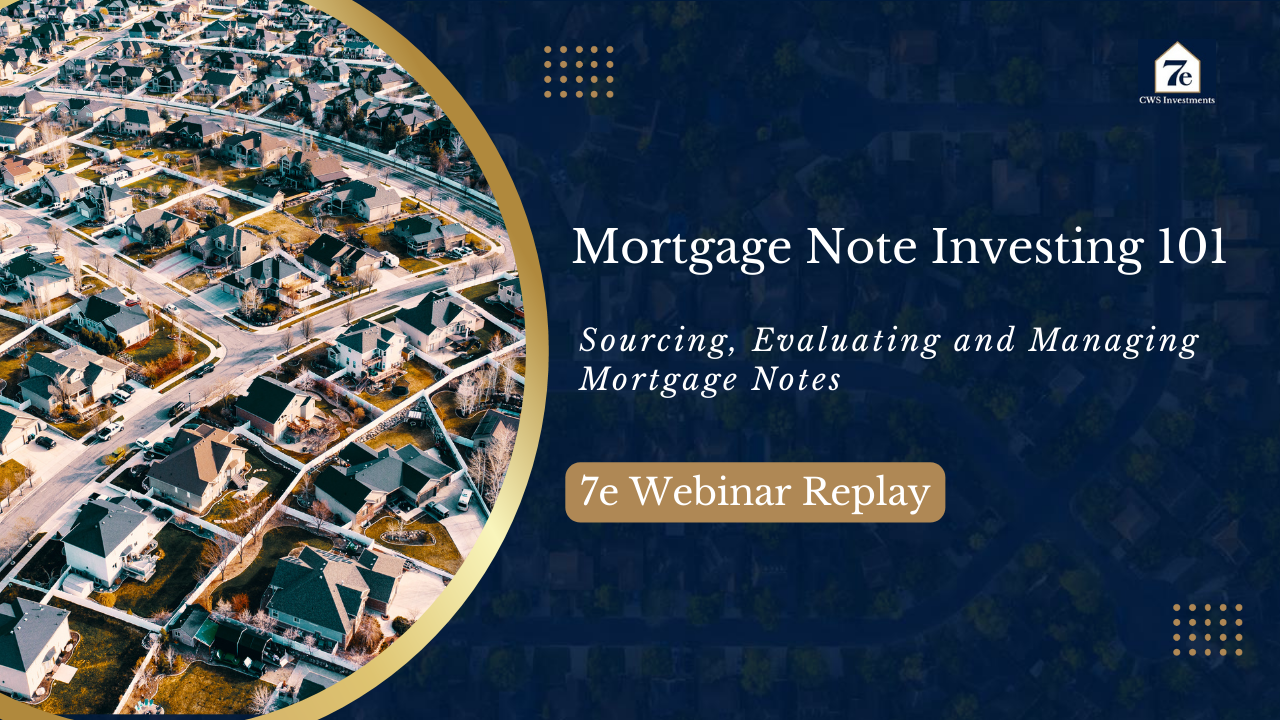
Watch the Webinar Replay: Mortgage Note Investing 101: Sourcing, Evaluating and Managing Mortgage Notes
In this in-depth webinar, Chris Seveney walks passive investors through the complete lifecycle of mortgage note investing, including sourcing assets on the secondary market, evaluating risk through disciplined underwriting, managing borrower resolutions, and structuring both accredited and non-accredited investment offerings.
This mortgage note investing webinar for passive investors provides a comprehensive look at how loans are acquired, how distressed debt is evaluated, and how internal asset management and legal coordination support structured portfolio oversight. The session also includes an overview of current accredited offerings and an announcement regarding the qualification of a Regulation A+ offering.
Mortgage note investing represents a real estate-backed investment strategy focused on collateral quality, borrower circumstances, and operational discipline. This webinar replay explains how conservative loan-to-value modeling, borrower-first resolution strategies, and structured underwriting guide long-term portfolio management.
Whether you are exploring mortgage note funds for the first time or conducting sponsor due diligence, this session provides foundational insight into how an experienced note manager approaches risk, execution, and capital structure.
If you missed the live session, you can now watch the replay below.
Webinar Overview for Passive Investors
This webinar is intended for passive investors seeking a detailed understanding of mortgage note investing and how portfolios are constructed and managed.
The session covers:
- The size and structure of the U.S. mortgage note market
- Why institutions sell performing and non-performing loans
- How loan tapes are reviewed and bids are structured
- The due diligence process prior to acquisition
- Borrower engagement strategies and foreclosure considerations
- Bankruptcy implications for secured lenders
- Accredited and non-accredited investment structures
The discussion is educational in nature and designed to help investors evaluate underwriting standards, operational execution, and sponsor discipline. It does not constitute investment advice or a solicitation.
What Passive Investors Will Learn
- How mortgage notes are sourced on the secondary market
- The distinction between performing and non-performing loans
- How conservative investment-to-value modeling helps manage downside risk
- How judicial and non-judicial foreclosure timelines affect strategy
- The role of Chapter 7 and Chapter 13 bankruptcy in secured debt
- How borrower resolution strategies may include modification, reinstatement, refinance, or property disposition
- How internal asset management and legal coordination influence outcomes
- How fund structures differ between Regulation D and Regulation A frameworks
- How portfolio diversification differs from investing in a single note
Whether you are ready to allocate capital or continuing your due diligence process, this session supports informed and structured decision-making.
Key Topics Covered
Market Size and Secondary Market Dynamics: The webinar explains the scale of the U.S. mortgage market and how consistent secondary market activity creates ongoing acquisition opportunities.
Acquisition and Conservative Underwriting: Loan tapes are screened using structured criteria, conservative loan-to-value assumptions, and market-adjusted valuations to manage downside exposure.
Borrower Resolution First Strategy: The preferred approach is working toward borrower reinstatement or modification before pursuing foreclosure when possible.
Legal, Foreclosure, and Bankruptcy Risk: Judicial timelines, secured lien position, and Chapter 7 versus Chapter 13 bankruptcy are factored into underwriting and resolution planning.
Exit Strategies and Capital Efficiency: Loans may be resolved through payoff, resale as performing notes, refinance, foreclosure, or property disposition depending on circumstances.
Operational Control and Internal Management: In-house asset management, attorney coordination, and servicer oversight are emphasized as central to execution and risk control.
Investment Structures and Regulation A+ Announcement: The session reviews Regulation D offerings and announces that the Regulation A+ structure has been qualified, with a separate informational webinar scheduled to review terms and investor considerations.
Who This Webinar Is For
This webinar is designed for individuals seeking passive investor education on private credit real estate, including those interested in mortgage note investing as part of a diversified portfolio.
It is appropriate for:
- Accredited investors evaluating Regulation D offerings
- Non-accredited investors seeking education about Regulation A structures
- Self-directed IRA investors
- Passive investors prioritizing collateral analysis and sponsor evaluation
This content is educational only and does not determine suitability for any individual investor.
Past performance is not a guarantee of future results. All investments involve risk.
This is your opportunity to discover a hands-off way to invest in real estate without tenants, toilets, or property management responsibilities.
Continue Exploring Note Investing With 7e
Ready to Start Investing?
Recent Comments