

What if You Could Access the Income Side of Real Estate Without Ever Managing a Single Tenant or Fixing a Broken Pipe?
Most investors assume real estate wealth requires physical property ownership. The most disciplined portfolios, however, often focus on the debt side of the transaction rather than the ownership side. If you want steady monthly income from real estate without the operational burden of direct property management, understanding how to buy mortgage notes is a logical next step.
This guide provides a straightforward roadmap for understanding what mortgage notes are, how they are sourced, how due diligence works, and how individual investors compare the direct approach against a professionally managed fund. We will also explain how 7e Investments approaches this asset class, including the structures available to investors today.
This content is for educational purposes only and does not constitute an offer or solicitation to sell securities. Investing in mortgage notes involves risk, including possible loss of principal. Past performance does not guarantee future results.
Key Takeaways
- Understand the shift from property to debt. Mortgage note investing provides real estate-backed income without the operational demands of physical property ownership.
- Master the sourcing process. Learning how to buy mortgage notes means understanding where loans trade, how to evaluate sellers, and how to access quality inventory.
- Apply disciplined due diligence. Protecting capital requires accurate collateral valuation, title review, and a clear understanding of the legal documents involved.
- Understand workout strategies. Active asset management, not foreclosure, is typically the most value-preserving approach to non-performing loans.
- Evaluate your path to scale. Direct note buying and a professional note fund are structurally different approaches with different operational demands, capital requirements, and risk profiles
The Fundamentals: Why Investors Are Becoming the Bank
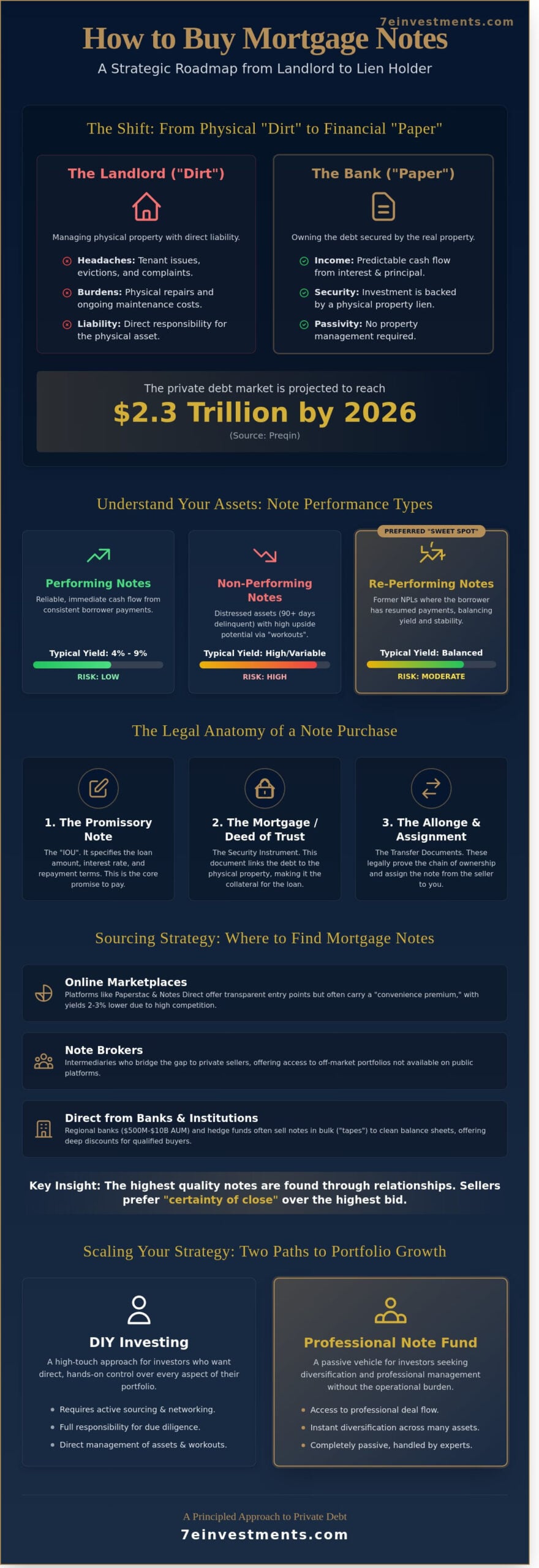
Traditional real estate investing requires active involvement: managing tenants, maintaining properties, and absorbing the operational demands of direct ownership. Mortgage note investing takes a different position. When you learn how to buy mortgage notes, you step into the creditor role rather than the ownership role. You are not buying the house. You are acquiring the debt secured by it.
A What is a Mortgage Note is a legal document representing a borrower’s obligation to repay a loan secured by real property. When a homeowner takes out a mortgage, two documents are created: the mortgage, which establishes the property as collateral, and the note, which establishes the borrower’s obligation to repay. Banks and lenders regularly sell these notes on the secondary market for balance sheet and regulatory reasons. This creates a market where disciplined buyers can acquire residential mortgage debt, often at a discount to the unpaid principal balance.
The income comes from loan payments, not from rents or property appreciation. The collateral is the underlying property. The position is that of a creditor, not a landlord.
Performing vs. Non-Performing Notes
Different loan types carry different characteristics and risk profiles.
Performing notes are loans where the borrower is current on payments. They generate immediate, recurring income. Yields vary based on the loan terms, acquisition price, and discount to unpaid principal balance.
Non-performing loans (NPLs) are loans where the borrower has fallen behind on payments. They are typically acquired at a deeper discount to unpaid principal balance, which creates an equity cushion and flexibility in the resolution process. The discount compensates for the additional work and uncertainty involved in bringing these loans to resolution.
Re-performing notes are former non-performing loans where the borrower has resumed payments under a modified loan structure. They can offer characteristics of both categories: a discounted acquisition price with an active payment stream.
At 7e Investments, the portfolio holds both performing and non-performing loans. The combination is intentional: performing loans provide stable income, while non-performing loans acquired at the right price create opportunities to recover additional value through disciplined asset management.
The Legal Anatomy of a Note Purchase
Understanding the documentation is essential when learning how to buy mortgage notes. Three documents define the ownership and transfer of a residential mortgage loan:
The Promissory Note: This is the borrower’s written promise to repay. It specifies the loan amount, interest rate, repayment schedule, and the consequences of default.
The Mortgage or Deed of Trust: This is the security instrument that links the debt obligation to the physical property as collateral. It gives the lender the right to foreclose if the borrower does not pay.
The Allonge and Assignment: These are the transfer documents. They establish the legal chain of title from the original lender to the current holder. A complete and unbroken chain of assignments is essential to enforce the note.
Reviewing all three documents thoroughly is a foundational step in the due diligence process for any note acquisition.
Sourcing Strategy: Where to Find Mortgage Notes for Sale
Identifying quality assets requires moving beyond passive searching toward active relationship development. Understanding how to buy mortgage notes effectively means knowing where institutional sellers operate and how to position yourself as a credible, qualified buyer.
Online Marketplaces: Platforms like Paperstac and Notes Direct provide a transparent entry point for individual buyers. They offer standardized closing processes and integrated due diligence tools. Assets on public platforms tend to be priced to reflect the competitive marketplace, which can affect available yields relative to off-market transactions.
Note Brokers: Brokers serve as intermediaries between sellers and buyers. They may manage pools of loans that are not listed publicly, connecting qualified buyers with sellers who prefer a more private process.
Direct from Banks: Community banks and regional institutions regularly sell mortgage notes as part of routine balance sheet management. Establishing a relationship with a secondary market desk or special assets officer at these institutions can provide access to inventory before it reaches broader distribution.
Institutional Sellers and Loan Pools: Larger financial institutions and private equity firms periodically sell pools of loans — often referred to as “tapes” — that list multiple loans available for bulk acquisition. Bulk purchases can offer deeper discounts, though they require significant capital and operational infrastructure to manage at volume.
Building Relationship-Based Deal Flow
Consistent access to quality inventory depends on reputation as much as capital. Sellers in the secondary mortgage market prioritize certainty of close. Buyers who demonstrate underwriting discipline, operational competence, and the ability to close efficiently tend to develop access to off-market inventory over time.
At 7e Investments, the team has built sourcing relationships across the secondary market over more than 10 years of operation. The firm evaluates a high volume of loans each month, analyzes a fraction in depth, and acquires a small number that meet the firm’s underwriting criteria. This selectivity is deliberate. The goal is not volume. It is quality.
Vetting the Seller
Due diligence begins with the seller, not just the property. Reviewing the complete chain of assignments from the original lender to the current holder is a required step. A break in the chain of title can create legal complications that affect the ability to enforce the note. Data tapes should be reviewed for consistency in payment histories and completeness of documentation. Understanding the seller’s motivation for selling, whether balance sheet management, regulatory capital requirements, or portfolio rebalancing, provides useful context for evaluating the asking price.
The Due Diligence Checklist: Protecting Your Capital
Disciplined verification is what separates a considered investment from a speculative one. When you master how to buy mortgage notes, you recognize that the value is not only in the paper itself but in the underlying collateral and the borrower’s situation. A thorough due diligence process covers collateral, title, legal compliance, and financial analysis.
Property Valuation: An updated valuation is required before any acquisition decision. Market conditions change. A valuation from prior years may not reflect current property value accurately. Obtain a current Broker Price Opinion or appraisal within a timeframe that reflects current market conditions. At 7e Investments, multiple valuations are obtained for every acquisition. The firm does not rely on a single estimate.
Title Review: Title integrity must be confirmed before acquisition. The review should verify that no senior liens, including delinquent property taxes or IRS liens, threaten the fund’s position. A clear title protects the collateral position throughout the note’s life.
Legal Document Compliance: Original loan documents should be reviewed for compliance with applicable lending laws, including the Truth in Lending Act (TILA). Compliance issues identified after acquisition can create legal exposure that affects the note’s value and enforceability.
Financial Math: Calculating Your Return
Understanding the economics of a note purchase requires looking beyond the stated interest rate.
Yield to Maturity accounts for the full economic return based on the acquisition price, the contractual interest rate, and the expected payoff date or resolution path.
Acquisition-to-Value (ATV): If a loan with a $100,000 unpaid principal balance is acquired for $72,000, the acquisition-to-value against a $200,000 property is 36%. This equity cushion is one of the primary risk management tools in note investing. The wider the cushion, the more flexibility the fund has in pursuing various resolution paths without taking a capital loss.
Servicing Costs: Monthly servicing fees paid to a licensed third-party servicer are an ongoing operational expense that affects net income. These costs should be accounted for in any return calculation.
Reviewing the Servicing Notes
The loan’s servicing history is a more current indicator of likely resolution outcomes than the original credit score. Borrower communication patterns, the nature of the delinquency, and the borrower’s stated circumstances all inform the workout strategy. A borrower who has maintained contact and experienced a temporary hardship presents a different resolution profile than a borrower who has been unresponsive for an extended period. Current servicing records from the recent period are more operationally relevant than historical origination data.
The assessment of borrower circumstances is one of the more nuanced parts of the acquisition process. At 7e Investments, the asset management team reviews this information individually for every loan before finalizing an acquisition decision. Identifying borrowers who want to remain in their homes and who have a realistic path to resuming payments is a key input in the underwriting process.
Managing the Asset: From Acquisition to Exit
Acquiring the debt is the first step. Managing the asset through to resolution is where outcomes are determined. Once you understand how to buy mortgage notes, the transition from acquisition to active management begins immediately.
Using a Licensed Loan Servicer is essential and not optional. Federal regulations, including the Fair Debt Collection Practices Act (FDCPA) and applicable state lending laws, govern how borrower communications and payment collections must be handled. A licensed servicer manages payment collection, escrow administration, tax reporting, and borrower outreach in compliance with applicable law. At 7e Investments, the servicer operates under the direction of the firm’s internal asset management team. The servicer executes instructions. All workout decisions are made internally.
The firm’s approach to asset management prioritizes resolution strategies that keep borrowers in their homes wherever financially viable. This is not only a responsible approach to the borrowers involved. It is also typically the most value-preserving path for the portfolio. A borrower who resumes payments under a modified loan structure generates more value over time than a foreclosure and property liquidation in most scenarios.
The Workout Process for NPLs
When a borrower is behind on payments, the asset management process begins immediately. The goal is to identify the resolution path most likely to recover value while supporting the borrower where possible.
Initial Outreach: The servicer establishes contact with the borrower to understand the circumstances behind the delinquency and to open a dialogue about available options. The tone is professional and solution-oriented, not adversarial.
Financial Review: The borrower’s current financial capacity is assessed. Income, expenses, employment status, and the nature of the hardship are reviewed to determine whether a sustainable modified payment structure is feasible.
Workout Structure: If a viable path exists, the team works with the borrower to structure a modification. This may involve adjusting the interest rate, extending the loan term, or restructuring the payment schedule to create an amount the borrower can sustain. A borrower who resumes payments on a restructured loan creates a re-performing asset.
Foreclosure as a Last Resort
Foreclosure is the resolution path when all workout attempts have been exhausted and no viable borrower solution exists. Timelines vary significantly by state. Non-judicial states typically allow for faster resolution through a trustee process. Judicial states require court involvement, which can extend timelines substantially. These differences in timeline and cost are factored into the acquisition price for every loan at the time of underwriting.
If the property is taken back through foreclosure, the asset management process continues through the disposition of the property. Because 7e Investments acquires loans at a discount to unpaid principal balance, the equity cushion built into the acquisition price often allows for capital recovery even through this path. Foreclosure is the final tool. It is not the preferred one.
Scaling Your Strategy: DIY Buying vs. Mortgage Note Funds
The path an investor chooses depends on their goals, available time, and operational capacity. Many investors begin researching how to buy mortgage notes individually because they want direct control over each asset. That control comes with real operational demands.
Note funds offer a structurally different approach. By pooling capital across a diversified portfolio managed by a professional team, investors participate in the asset class passively. The trade-off is direct control for operational simplicity and geographic diversification.
The Hidden Costs of Doing It Yourself
Direct note ownership carries costs that do not always appear in initial return projections. Legal fees for foreclosure proceedings in judicial states can be substantial and extend over long timelines. Servicing fees, document management, title review costs, and ongoing compliance requirements are ongoing operational expenses. Managing even a small number of non-performing loans requires specialized knowledge of state-specific legal procedures, servicer oversight, and borrower negotiation.
Without sufficient portfolio diversification across multiple loans, a single non-performing asset can meaningfully affect overall returns. Building that level of diversification independently requires significant capital and time.
Investing Through the 7e Fund
For investors who want exposure to the mortgage note asset class without the operational demands of direct ownership, 7e Investments offers a professionally managed alternative.
The firm has completed six full-cycle funds over more than 10 years of operation. Across the five verified prior closed funds, the team returned an average weighted IRR of 14.5% to investors, with no missed distribution payments and no lost investor principal across any prior fund. These figures come from independent third-party track record verification and reflect the structural differences across those five funds. Past performance does not guarantee future results.
The current offering is the sixth fund. Distributions have been paid monthly since inception. No distribution payments have been missed. No investor principal has been lost. Past performance does not guarantee future results.
7e Investments manages a nationally diversified portfolio across 20-plus active states, with historical acquisitions in more than 40 states. The firm is SEC-regulated, submits annual audited financials through Grant Thornton, and maintains 3 to 5% of capital in reserves. No leverage is used to acquire notes held on the core portfolio.
Investors receive monthly distributions on the first business day of each month, access to portfolio reporting through the AppFolio investor portal, and quarterly updates. The firm does not charge management fees. The full invested amount earns interest from the first day of accrual.
Minimum investments start at $5,000 for Reg A+ classes and $100,000 for Reg D classes. A full breakdown of available classes, rates, and terms is available in the offering circular: https://7einvestments.com/offeringcircular2-0/
Register for our webinar to learn more about how the fund works and whether it may be appropriate for your portfolio.
Master Your Financial Future Through Private Debt
Learning how to buy mortgage notes is a substantive undertaking. It requires understanding real estate debt structures, legal documentation, due diligence methodology, servicer oversight, and state-specific legal processes. For investors willing to build that operational capability, direct note ownership offers hands-on involvement in each asset. For investors who want real estate-backed income without the operational complexity, a professionally managed note fund provides a passive alternative.
7e Investments brings more than 10 years of mortgage note experience, a team of 12 full-time employees, and a track record of disciplined underwriting and consistent investor distributions to every fund it operates. The firm manages assets across 40-plus states with a documented process for loan acquisition, workout, and resolution.
The decision about how to participate in this asset class starts with understanding it. That is what this guide is designed to support.
Book a call with our team to discuss whether the 7e Investments offering is appropriate for your situation.
Frequently Asked Questions
Yes. Individual investors can legally purchase mortgage notes through the secondary market. Mortgage notes are a standard asset class in private debt markets. Federal laws including the Truth in Lending Act and the Fair Debt Collection Practices Act govern various aspects of these transactions. Investors should consult qualified legal counsel regarding their specific circumstances and any applicable state requirements.
Capital requirements for direct note purchases vary depending on the loan type, property value, and market. Individual notes can range from small balances on junior liens to six-figure positions on primary residential mortgages. For investors considering a professionally managed fund, 7e Investments offers Reg A+ classes starting at $5,000 and Reg D classes starting at $100,000 for accredited investors. All bonds are priced at $1,000 per bond in exact multiples. Refer to the offering circular for full class details.
The primary risks in non-performing note investing include borrower non-resolution, where the borrower neither resumes payments nor cooperates with a workout and foreclosure becomes necessary; property value decline, where the collateral erodes below the acquisition price; and legal and timeline risk, where state-specific foreclosure processes extend the resolution period and increase costs. Acquiring notes at a meaningful discount to unpaid principal balance is the primary structural tool for managing these risks. Investors should review the full Offering Circular for a complete discussion of risk factors: https://7einvestments.com/offeringcircular2-0/
Yes. Investors may use a self-directed IRA or other eligible retirement account to invest in mortgage notes. For 7e Investments specifically, the fund is structured as a C-Corporation with no leverage on its core portfolio, which means there is no Unrelated Business Income Tax (UBIT) or Unrelated Debt-Financed Income (UDFI) exposure for retirement account investors. Investors should confirm this with their SDIRA custodian and consult their own qualified tax advisor regarding their specific situation.
A bankruptcy filing triggers an automatic stay that pauses all collection and foreclosure activity while the court process proceeds. The lien on the property remains intact through the bankruptcy. Chapter 13 bankruptcy, in particular, often results in a court-approved repayment plan that can provide a structured path to the borrower resuming payments. Resolution timelines extend during a bankruptcy proceeding. The equity cushion built into the acquisition price is one of the primary tools for managing this timeline risk. Investors should consult qualified legal counsel regarding bankruptcy-related considerations in their specific situation.
Ownership is verified through a complete chain of assignments from the original lender to the current seller, confirmed against the original wet-ink promissory note. Each assignment in the chain must be properly executed and, where required by state law, recorded with the county recorder. A break in the chain of title can affect the ability to enforce the note in a legal proceeding. Reviewing county recorder records to confirm a recorded Assignment of Mortgage is a standard part of the title review process.
A real estate license is generally not required to purchase and hold mortgage notes for your own investment portfolio. Licensing requirements typically apply to individuals brokering note transactions on behalf of third parties or servicing loans under applicable state and federal regulations including the SAFE Act of 2008. Requirements vary by state. Investors should consult qualified legal counsel regarding the specific requirements applicable to their situation.
Banks and lenders sell mortgage notes for practical balance sheet and regulatory reasons. Federal capital requirements mean that loans, particularly non-performing ones, tie up regulatory capital that could otherwise support new lending. Non-performing loans also require ongoing loss reserves, internal servicing resources, and legal oversight. Selling these loans to specialized buyers allows banks to free up capital, improve balance sheet ratios, and focus on loan origination rather than loan workout. The discount reflects the additional work, timeline, and uncertainty associated with resolving the loan. For disciplined buyers with the expertise to manage the workout process, that discount creates the equity cushion that anchors the investment’s risk profile.
Investing in mortgage notes involves risk, including possible loss of principal. This content is for educational purposes only and does not constitute an offer or solicitation to sell securities. Past performance does not guarantee future results. Investors are encouraged to review the full Offering Circular at https://7einvestments.com/offeringcircular2-0/ before making any investment decision. 7e Investments does not provide tax or legal advice. Consult a qualified advisor regarding your specific situation.
Continue Exploring Note Investing With 7e
Ready to Start Investing?